Sunday, March 23, 2014

Gregor's Isolation: Metamorphosis

Franz Kafka's Metamorphosis tells the story of Gregor Samsa, a traveling salesman who lives with his family. Gregor is burdened with paying off his parents' debt while they do no work and don't help pay off the debt. This devotion to his family's problems is holding Gregor back from his dreams. "Once I’ve got together the money to pay off my parents’ debt to him—that should take another five or six years—I’ll do it for sure" (Kafka 2). Gregor's parents are holding him back from his one ambition. To take this one step further, Gregor is holding himself back from this ambition. He chooses to spend his life working long hours for years, and he uses his parents as an excuse to justify his lonely, miserable life. His life is also exemplified by the picture of a stranger in his room. "Above the table ...  hung the
picture which he had cut out of an illustrated magazine a little while ago and set in a pretty gilt frame. It was a picture of a woman with a fur hat and a fur boa" (Kafka 1). Usually, people place pictures of loved ones in their homes, and framed photos are almost never of strangers, as frames require more work than just paper. This tells the reader that he has no true loved ones, even his family, to frame. A life with no loved ones cannot be a very happy or fulfilling one, and Gregor's is no different.


Moving on to the central piece of plot in the story, Gregor gets turned into a bug, and yet does not react in any sort of hysterical or surprised manner. His reaction is subdued and lackadaisical, which is very different from a normal reaction to this situation. "'What’s happened to me,' he thought. It was no dream ... Gregor’s glance then turned to the window. The dreary weather—the rain drops were falling audibly down on the metal window ledge—made him quite melancholy"(Kafka 1). He acknowledges his change and then moves his attention to the weather and then later  his work, as if that's the more pressing matter at the time. This mundane response is strange, and must mean that he cares more about his obligations than himself. He constantly thinks about how his family will be worried about him and how his boss will inquire on his whereabouts, showing how many people or dependent on him. His entire family knocks on his doors at different times to check in on him and his manager eventually comes as well to see why he isn't working (Kafka 3-4, 7). This can be interpreted multiple ways. The first is that many people rely on him to do his work and take care of them. Gregor is then seen as selfless and noble. Contrastingly, this dependence can also be seen as his family and employer taking advantage of him. Then Gregor is seen as pitiable and a servant to his loved ones. Either way he cares more about his duty than his livelihood.


Monday, March 17, 2014

Dante's Inferno vs. What Dream May Come -- (BP #26)

After watching What Dreams May Come, it is hard not to recognize the parallels from the movie to Dante's book, Inferno. There are indeed many of these parallels, including the impetus, or motivation, of the journey itself. In Inferno, Dante has undertaken this perilous journey through the most terrible of places because Beatrice is in Paradiso, and he emotionally needs to join her. In the movie, Chris journeys to hell for his love, as well. Annie is stuck in hell and he needs to rescue her and take her back to heaven. These goals by both the heroes is noticeably similar, and is a red flag to how these two pieces relate.


Another similarity between the book and the movie is the guides both protagonists have at their disposal during their time in the world of the afterlife. Chris has multiple, but all three serve the same purpose, as well as Virgil in the Inferno. These guides tell the main characters how every place they go works. 'Doc' and Leona tell Chris how heaven works, and the Tracker tells how hell works, and guides him to the different levels, and eventually to Annie's level. Virgil does the same thing; he guides Dante down through the levels of hell and brings with him wisdom and knowledge.


Franz Kafka Research (BP #27)

Franz Kafka was born in Prague, on July 3rd, 1883. He was born to Hermann and Julie, who resided in the middle class at the time, and who were Jewish. Hermann had been a traveling salesman and eventually brought the family to Prague, where he opened a retail business. Franz was the eldest of six children; there were three boys and three girls. Franz's two younger brothers died in infancy. He had a lonely home life, as his parents were out of the house most days working at the family business. He consequently had a series of governesses and a difficult relationship with his father.


Kafka, after receiving good grades from his lower schools, went on to the German Charles-Ferdinand University of Prague in 1901. He started to study chemistry, but switched to law after two weeks, because a law degree offered many career options, which his father liked. During his time at the college, he took language courses and joined a literary club of students. Literature and writing took hold of him from that moment on. After serving his obligatory year of work under an aggressive Italian insurance company, he found a job with less strict hours to focus on his writing. He later got married to Felice Bauer, and diagnosed with Tuberculosis, which ultimately killed him.


He was influenced by many people. It starts with his father, with whom he had a difficult and complicated relationship. Hermann undoubtedly influenced Franz's writing and he even wrote Letters to His Father, which goes in depth on their relationship. At the university Kafka much liked reading the works of Fyodor Dostoyevsky, Flaubert, Franz Grillparzer, and Heinrich von Kleist, whom he considered his true brothers. He also was very fond of the works of Goethe. He has influenced the world after him in a unique way. People rarely quote Kafka, but instead cite his ideas and perspectives.


Franz died on June 3rd, 1924. His tuberculosis had worsened and he returned from Berlin to Prague and his family. He eventually went to a treatment facility in Vienna where he died. He was buried in Prague in a Jewish cemetery. It is generally agreed upon that Kafka also suffered from other ailments, such as depression, anxiety, insomnia, and migraines, which may have had an affect on his tragically short life. His legacy lives on through the admirers of great works, of which his are.


Works Cited
"Franz Kafka Biography." A Short Biography of Franz Kafka. N.p., n.d. Web. 17 Mar. 2014. <http://www.kafka-online.info/franz-kafka-biography.htm>.
"Franz Kafka." Wikipedia. Wikimedia Foundation, 15 Mar. 2014. Web. 17 Mar. 2014. <http://en.wikipedia.org/wiki/Franz_Kafka>.
"Kafka's Life (1883-1924)." The Kafka Project. N.p., n.d. Web. 15 Mar. 2014. <http://www.kafka.org/index.php?biography>.

Monday, March 10, 2014

Blog #25: Week Reflection Mar. 3-7

This week was all presentations! I had no stress whatsoever this week in LA, since I went the previous Friday. This felt really good and allowed me to catch up in other classes at home. The presentations have continued to be very good and I have enjoyed them very much. One in particular was Noah's. His visual was very entertaining and extremely creative. First of all, his canto was about the liars or deceptors sent to hell. These people are two-faced in hell because they say they are one thing, but turn out to be completely different. So for his visual, he brought in a piñata that was burned on one side, to represent the two faces of the sinners. Also, during his presentation, he told the class there was candy in the piñata like there should be, but when it was opened there were vegetables instead. This was really mean in the moment but was a great interactive representation of his canto.


All the others were good, too, but as I had feared, they do get quite repetitive. It is hard to stay interested just because we haven't read the whole Inferno through. We only had our canto and stuck to it. This isolation, for me, made the others less interesting. One I thought was interesting, though, was Canto 20, which Garyn presented on. This canto was about the diviners, and was interesting to me because diviners have been very influential in early history, yet Dante puts them in Hell. It is just interesting to see how Dante thinks about certain people and apply the punishments to his time to make more sense of the book itself. I thought this unit was pretty interesting and it combined Campbell's hero's cycle with Aristotle's tragic hero.

Monday, March 3, 2014

Blog #24: Week Reflection Feb. 24-28

Last week was a little hectic for me. I had gotten a slow start to my Dante project due to a mini-vacation to Stanford University, and it definitely did not help to have one of the earlier cantos. But I worked hard! I got things done in class and used my time at home effectively, as well. When I finally presented  on Friday, I thought I had a very good piece of work and I was proud of it. Although it was stressful to complete the project in a seemingly short amount of time, I am very happy now that I was in an early slot in our lineup. This is because now I get to relax and watch my classmates' amazing projects, with no worries.


I thought the presentations on Thursday and Friday last week were very good. The thing that stood out most to me was the visual presentations, because they were stupidly good. It was definitely humbling to my artistic ability, as if I had any in the first place, and frankly, it made me feel a little worse about my own visual. The pit bull behind bars was so amazing, it brought a small, barely noticeable tear to my eyes. And the city street made in digital art and its incredible details, astounded and befuddled me. I look forward to seeing more of these, but I worry about the repetitiveness of the presentations, and if I will be able to stay engaged, as my peers deserve.

Monday, February 17, 2014

Blog Post #23: Week of Feb. 10-14 Reflection

Last week, we swiftly wrapped up our tragic hero unit with our poster presentations. These went very well and they were very interesting and well done. I particularly liked the Alex Supertramp poster from the movie Into the Wild. This group did a great job of decorating their poster and adding symbols and meaningful items. For example, they wrote the hero's name in twigs, and had flowers around this. These items make the audience feel the wildness of the movie and lack of society that is the premise. I liked these presentations and I think they helped me get a very firm grasp of the topic that I would not have gained unless exposed to this many examples.


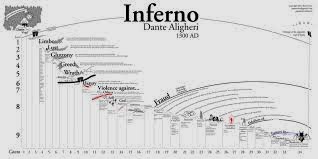
On Thursday, we shifted gears and focused on another very dark topic: hell. We will be studying Dante in the following weeks and his in depth description of the nine levels of hell. This includes who can be placed there, and what punishments are included in the package. Looking at a map of Dante's Inferno, some of the punishments are very gruesome and terrifying. For example, I would hate to have to live eternally in a pit of boiling tar and pitch, with flying demons hooking me with sharp barbs. This will be an interesting topic and although it is very dark, I hope to gain something out of it, as I'm sure I will.

Thursday, February 13, 2014

Blog Post #21: Personal Hell

The first question on the assignment page is: What is hell? Before I can answer this, there are many interpretations I can take. The first is the hypothetical idea of hell that is traditionally thought of in the Christian faith. This direction leads me to think of it as a fire-filled place underneath the Earth where every second is agony and torturous. The devil roams and instills fear and pain in unimaginable magnitudes. My personal hell leads my onto a completely different thought line. While equally as torturous, my hell has no fire or devil. It is bare and enclosed, with no one around and no noise. I am pitifully alone and hate every second of it. Meanwhile, a sideshow in my head instills fear into my mind with memories of all the pain I have gone through, to make me feel it all over again. I become very vain in my hell, and I can't help but think that there are others that think bad things of me, and consequently make me feel terrible. This mental torture seems to have no escape or reprieve.


1. My hell is a punishment, as could be expected. It is a punishment for the bad things I have done or not done. My hell can come at any point, really, and is not restricted to the afterlife or any such thing. Whenever I feel really bad about something I can sink to hell, and it is awful. This is usually a result of self-criticism, and an I-hate-myself felling. These feelings are not merited but yet something in me brings about this personal hell.

2. The punishments of my hell are many different methods of mental torture. In my hell, the mental aspect of life trumps the physical aspect, and so no cuts, bruises, or breaks befall me. I am tortured by my own mind, telling me that I am worthless and pointing out all my flaws. And I believe it for some reason. My mind resembles that of a dreaming mind, where anything that comes along, inextricable as it may be, is not only believable, but completely accepted as fact. All my mistakes are flashed on the walls of the box I am trapped in as some kind of subliminal messaging, and its purpose is to convince me of my infinite inferiority.

3. My hell is white, and lonely. It may be one of those cells used in insane asylums. The ones with padded walls and no windows. This means there is no emotion going out to others, which I believe is the reason for emotions in the first place. It is all coming back to me, and they are negative in nature, wearing my defenses down and making me unstable, and insane. Pictures and scenes are displayed on the walls as in a slideshow presentation, but there is no projector. These scenes tear at me with their sharp claws of self-deprecation, giving me no rest or rescue.


4. There seems to be no end to my hell. There is no escape, at least for me. But that is the point of a personal hell. It is meant to be the worst-case scenario, the most terrible situation imaginable by that specific person. If someone else were placed in my hell, that person might have a chance of escaping, by denying the attempts of the pictures to gnaw at his or her mental stability. I don't think any one's personal hell should be escapable, and if it is, it is not their true hell.

5. A symbol for my hell could be a straightjacket. I am restrained in my hell and have to take whatever it throws at me. I can't get out of it and, although not claustrophobic in the real world, I freak out in my hell trying to get free. But these attempts are futile. Everything is futile in hell. The idea of being restrained or having no options generally scares me, and the straightjacket would be perfect to terrify me in my hell.


6. Absolutely no one is in my hell. That, for me, is worse than having a devil or person I dislike. There may be ghosts or ethereal wisps of people I love, though. This is because they are not really there but they would be noticeable and torturing. I would more than anything want to talk to them, or to hug them, but it would be impossible. Humans were made to group together and form communities, as we have been doing for all of time, so being alone goes against human nature and is complete misery. That is why it is intrinsic to my hell.